Maha Shakti Yoga
traditional kundalini meditation
AS TAUGHT BY GURU MAHAN
Tuesdays 19:00 – 20:30
Zentralstrasse 123
8003 Zürich
| CHF 30 |
Sundays 10:30 – 12:00
Jupiterstrasse 42
8032 Zürich
| donation based |

but Why ?
In ancient times, people devoted a lot of time taking care of their bodies and minds.
With limited desires and little stress, they lived in balance, physically strong and mentally clear – healthy. But as time has passed, humanity’s search for a better life led to remarkable growth in science and technology.
This drive of progress has set humanity on a fast-paced path – often at the cost of physical and mental well-being.
Modern lifestyles have made us vulnerable to illness, poor eating habits and environmental stress. As mental clarity declines, our ability to work with focus and purpose suffers, creating a cycle of stress and imbalance.
In the midst of this, many are returning to an ancient, time-tested path:
Yoga.
A sacred gift from the sages which offers more than just physical movement – it is a holistic science for body, mind and soul. It is the key to restoring balance, health, and inner peace in a world that so deeply needs it.
HISTORY
A look into ancient Indian tradition shows that the roots of Yoga are deeply grounded into the fabric of Indian culture.
Yoga is not a religion – Through timeless principles, it guides the regulation of physical, mental and emotional energies.
The sage Patanjali, often honored as the Father of Yoga, was the first to systematically compile the teachings of Yoga into written form – the Yoga Sutras, written in Sanskrit.
Yet Yoga itself is far older. Long before Patanjali, our ancestors lived and practiced these sacred teachings as a way of life.
MEANING
The word Yoga comes from the Sanskrit root “yuj”, which means to join, to unite or to merge.
At its essence, Yoga is the union of the individual self with the Divine – the merging of our soul with the universal consciousness.
This sacred union leads to the experience of oneness – a deep inner knowing that we are not separate from the universe, but part of its infinite wholeness.
The main goal of Yoga is to bring harmony between body, mind, and thoughts through regular and mindful practice.
When practiced consistently, Yoga supports both mental clarity and physical vitality, strengthening the body’s natural ability to resist disease and calming the fluctuations of the mind.
AIM
It enhances focus, memory and inner strength, allowing us to face life with greater stability and awareness.
Ultimately, Yoga prepares us to act with peace, purpose and presence – aligning our actions with our true self.
The benefits of Kundalini awakening are profound:
Physically, it revitalizes the nervous and endocrine systems, supports healing, enhances energy flow and brings deep relaxation.
Mentally and emotionally, it relieves stress, transforms negative patterns, and awakens clarity, strength and emotional stability.
Intellectually, it enhances creativity, focus, intuition, decision-making and higher intelligence.
Spiritually, it opens the chakras, expands consciousness, and leads to deep inner transformation – ultimately guiding the practitioner toward Self-realization.
PRACTISE
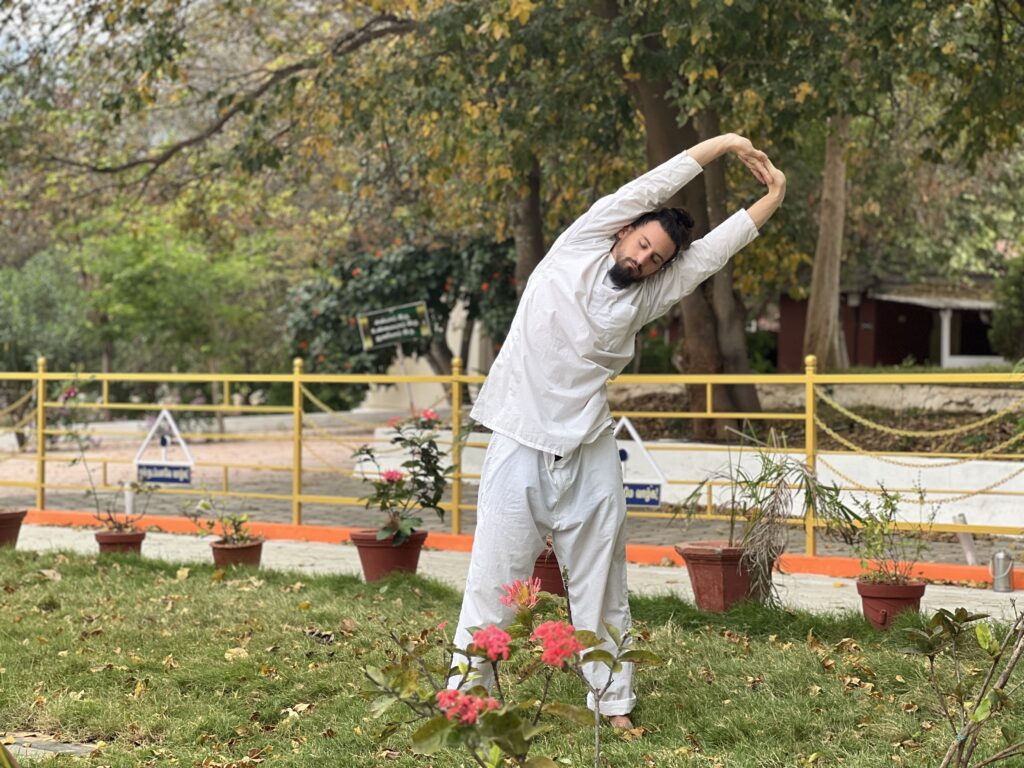
ASANA – The Foundation of Stillness
Asana, meaning „seat“ or „posture“ in Sanskrit, is the third limb of the eightfold path of Yoga (Ashtanga Yoga).
It refers not only to physical postures but to the ability to sit with steadiness and ease – as described by Patanjali:
„Sthira Sukham Asanam“ – A posture should be stable and comfortable.
While ancient texts mention thousands of asanas, modern practice focuses on key postures that promote:
Physical strength and flexibility | Nervous system regulation | Organ function and digestion | Energy flow through chakras and nadis
More than exercise, Asana is preparation – it stabilizes the body and stills the mind so that one can enter deeper states of awareness through Pranayama, Mantra and Meditation.
Pranayama – Mastery of the Life Force | BREATH
Pranayama is more than breath control — it is the art of harmonizing the flow of Prana through the Nadis (energy channels), awakening inner balance, clarity and vitality.
Pranayama is the conscious regulation of breath – the bridge between body, mind and spirit.
The word comes from Prana (life force) and Yama (control), pointing to the science of channeling the vital energy that sustains all life.
These techniques cleanse and activate the energy system, improve lung capacity and sharpen mental focus. Breath becomes the tool to calm the mind, increase awareness and prepare the body for deeper practices like meditation.
The Nadis – Ida, Pingala, and Sushumna – are essential energy pathways.
Ida (left nostril): brings cooling, calming energy.
Pingala Nadi (right nostril): brings warmth and activation.
Subhumana Nadi (central channel): awakens spiritual energy, balancing both.
Through regular and mindful practice, Pranayama purifies the system, improves emotional well-being, and enhances concentration, relaxation, and spiritual perception.
MANTRA – SACRED SOUND
helps focus the mind and attune us to higher vibrations, lifting our consciousness.
Kundalini Meditation
Kundalini is the divine energy that exists within every human being – a sacred force that, for most, lies dormant and unawakened. It is the subtle power behind all creation, often described as the coiled serpent resting at the base of the spine, in the Mooladhara chakra.
For many, this powerful energy remains asleep for an entire lifetime, hidden beneath layers of conditioning and unawareness. Yet for some, it awakens – sometimes spontaneously, often through intense spiritual practice. When awakened, it enhances natural abilities, fuels creative expression, sharpens intuition, and deepens presence. Whether or not one is conscious of it, it is Kundalini Shakti that illuminates the lives of gifted thinkers, artists, visionaries, and seekers.
While spontaneous awakening is rare, Kundalini can be consciously activated through yogic practices such as Pranayama, Bandha, Kriya, or more traditionally, through Shaktipat – the transmission of energy and grace from an enlightened Master or Guru.
Once awakened, the energy rises through the Sushumna Nadi, activating the seven chakras and purifying the physical and subtle bodies.
Kundalini Meditation is the practice of sitting in stillness, gently observing the rise of this sacred energy – especially at the Ajna Chakra (third eye) and Sahasrara (crown). Through focused awareness, the energy begins to flow, dissolving duality and revealing our natural state of
peace, unity and divine presence.
